.png)

Red Clover (Trifolium Pratense) Monograph
Updated: Mar 19
Trifolium Pratense
Fabaceae, Bean family
Native to Europe, Western Asia, and northwest Africa
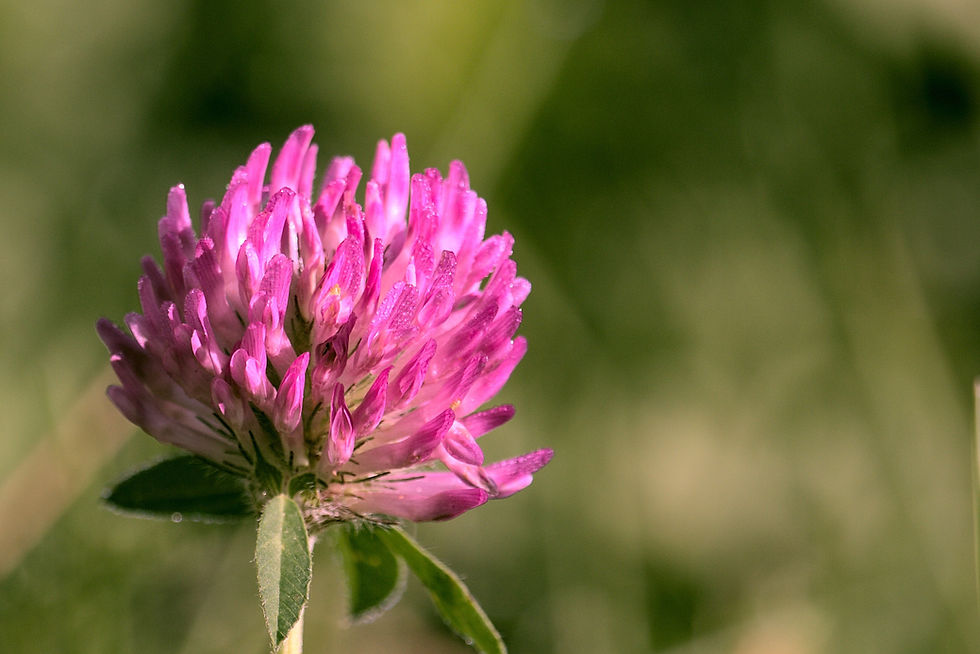
Clover is native to Europe, Western Asia, and northwest Africa. Today this nutritive plant is a wild edible that can be found in many backyards. The leaves are usually in sets of three, hence four leaves being associated with luck. The leaf of the white clover tends to be more round while the red clover leaves are narrower and more angular. The green smooth leaves have white crescent markings on them. White clover tends to trail along the ground as a cover, but the plants do trail upwards on the flower stems. There is one flower per stem; the stems are greenish to reddish. The flowers of the red clover tend to be pinker but will dry to a reddish hue. The white clover flowers are white with a pinkish tint towards the bottom of the flower.
If you’re realizing you don’t just need more herbs—you need a process to understand them—download the Steps to Becoming an Herbalist guide.

Foraging Notes & Identification Tips
Clover is one of those plants that many people overlook because it grows so freely, but that does not mean it should be gathered carelessly. Just because something is common does not mean it is automatically safe to harvest from any location.
You want to pay attention to where it is growing. If the area has been sprayed with pesticides, treated with chemicals, or is near heavy traffic, you do not want to use those plants. The same way clover pulls nutrients from the soil, it will also pull in whatever contaminants are present.
Clover prefers open areas with plenty of sunlight. You will often find it in lawns, fields, and along pathways. When harvesting, choose plants that are vibrant, free from browning, and not covered in insect damage. Avoid anything that looks stressed or diseased.
When gathering flowers, pick them when they are fully open but still fresh. The color should be bright, not faded. The leaves should be soft and green, not dry or brittle. Harvest gently and leave plenty behind so the plant can continue to grow and spread.
Energetics & Actions:
Clover has a mildly sweet, and salty taste. The sweet taste is usually symbolic of a moistening quality which clover does have. It manages to be both demulcent and alterative, so it has an effect of adding or reducing the amount of body in the tissues. Red clover is a lymphatic herb, meaning it helps to drain excess lymph fluids.
Clover contains phytoestrogens. It is used for regulating hormones and the symptoms of menopause. Red clover is also used for dry conditions of the throat. Red clover is useful for redness of the skin, any skin irritations or dry conditions such as eczema.
Neutral to Cool Moistening Diuretic
Alterative Antitumor Estrogenic
Nutritive

This and 150+ other monographs can be found inside the textbook:
Preparations:
Red clover can be used in a poultice or salve for skin conditions. It makes delicious tea, colorful vinegar or glycerin extract. Red clover pairs well with chickweed and cleavers for the lymphatic and alterative properties for internal preparations, and for external skin irritation.
Red clover is a mild laxative and blood cleanser (red), it also stimulates cleansing of the lymphatic system. The crescent in the leaves was thought to resemble cataracts, In Spain it was traditionally used for this purpose. It is used for wound healing, psoriasis and eczema.
It is considered safe for children that have mild skin conditions (It works best in slow doses that are gradually increased). It works well combined with other herbs; combine with thyme for coughs and congestion, combine with Echinacea for skin issues, use with calendula for swollen breasts and yellow dock for cleansing the lymphatic system.
A lotion from the tea can be used to make a 220 skin wash for persistent sores, inflamed skin and swollen insect bites. Red clover can be used as a poultice on swollen, tender glands, make a decoction with the flowers and strain while warm. Contraindications: Do not take concentrated extracts of Red Clover while pregnant or breastfeeding.
Reading about herbs is one thing. Knowing how to choose and combine them is another. The Steps to Becoming an Herbalist guide breaks that down simply.
FAQ: Foraging Clover
How do I know if clover is safe to harvest?
You need to know the environment it is growing in. If the area has been sprayed with pesticides or exposed to pollution, do not use it. If you are unsure, leave it. Safe harvesting starts with knowing the land.
Can I pick clover from my backyard?
Yes, if you have not sprayed your yard within the last few years. If chemicals have been used, it is best to wait before harvesting or find another location.
What part of clover do I use?
Both the flowers and leaves are used. The flowers are most commonly used for teas, extracts, and topical preparations, while the leaves can also be added to infusions or used fresh.
When is the best time to harvest clover?
Harvest when the flowers are fully open and vibrant. Avoid harvesting when the plant is wet from rain or dew. Midday, after the moisture has dried, is usually best.
How much clover should I harvest?
Only take what you need and leave the rest. This allows the plant to continue growing and reseeding. Foraging is not about collecting everything—it is about working with what is available.
Can I use clover right after harvesting?
Yes, clover can be used fresh, but it can also be dried for later use. If drying, make sure it is done in a well-ventilated space to prevent mold.
Are there lookalikes I should be aware of?
Clover is generally easy to identify with its three-leaf pattern and round flower heads, but you still want to take your time and observe carefully. If you are unsure, do not harvest until you are confident in your identification.


.jpg)
Comments